Introduction
Flying with a cat or small dog can be surprisingly stressful when you are unsure whether the carrier will actually fit under the airplane seat. A carrier may look compact at home but become difficult to slide beneath a seat once you account for seat supports, limited clearance, and the airline’s specific requirements. That is why choosing one of the best airline approved pet carriers is about more than buying a bag labeled “airline approved.”
For in-cabin travel, the carrier needs to fit beneath the seat in front of you, provide adequate ventilation, keep your pet safely contained, and give the animal enough room to stand, turn around, and lie down comfortably. The exact rules are determined by the airline and can vary according to aircraft type, cabin, and seat location. The FAA also states that airlines decide whether pets may travel in the passenger cabin and that an in-cabin pet carrier must remain properly stowed under the seat during taxi, takeoff, and landing.
The right carrier therefore needs to balance two things: your pet’s comfort and the physical limitations of an airplane cabin. This guide explains what to look for, how under-seat sizing works, and which features matter most when choosing an airline-ready carrier.
What Makes the Best Airline Approved Pet Carriers?
The phrase “airline approved” can be misleading. There is not one universal carrier size that every airline accepts. Instead, individual airlines establish their own rules, and those rules can differ between aircraft and routes.
For example, American Airlines currently recommends soft-sided carriers and gives a maximum guideline of 18 x 11 x 11 inches for soft-sided carriers, while its hard-sided dimensions differ by aircraft type. American also requires the pet to remain inside the carrier under the seat for the entire flight.
Southwest similarly requires the carrier to fit under the seat and specifies maximum dimensions for acceptable carriers. It recommends soft-sided carriers because under-seat space can vary according to the aircraft and seat location.

This is why the best airline approved pet carriers are not necessarily the largest carriers you can find. A carrier that reaches the maximum published dimensions of one airline may be too large for another airline or a different aircraft.
Soft-Sided Construction Matters
For most in-cabin flights, a soft-sided carrier is the practical choice. Soft materials allow a small amount of flexibility when the carrier is placed beneath the seat, while a rigid carrier has very little room for adjustment.
That flexibility does not mean you should force an oversized carrier into a small space. The carrier should slide under the seat without excessive compression, and ventilation panels should remain unobstructed.
A good soft-sided carrier should also maintain its shape well enough that the interior does not collapse onto your pet. Reinforced sides, a stable base, strong zippers, and secure stitching are particularly important when the carrier will be handled repeatedly during airport travel.
Why Under-Seat Fit Is the Most Important Feature
The biggest mistake travelers make is shopping by appearance instead of measurements. An attractive carrier can still be unsuitable if its exterior dimensions exceed the airline’s limit.
The FAA requires an in-cabin pet container to be small enough to fit beneath the seat without blocking a person’s path to the main aisle. It must also remain properly stowed while the aircraft is moving on the airport surface and during takeoff and landing.
Under-seat space is not necessarily a perfectly open rectangle. Seat supports, electrical equipment, structural components, and different seat designs can reduce usable space. A carrier that fits comfortably beneath one aircraft seat may therefore feel tighter on another aircraft.
Before buying, measure the carrier from its outside edges rather than relying on the interior dimensions. Include protruding handles, wheels, frames, and other permanent components when determining its overall size.
Why Height Can Be Especially Tricky
Length and width are usually easier to accommodate because the carrier can be positioned horizontally beneath the seat. Height is less forgiving because the floor-to-seat clearance may be limited.
This is another reason soft-sided construction is useful. A flexible top can sometimes conform slightly to the available space without damaging the carrier. However, the carrier should never be compressed so much that your pet cannot sit, turn, or breathe comfortably.
Ventilation Should Never Be an Afterthought
Good ventilation is essential during air travel. Airports can be crowded, noisy, and warm, and your pet may already be experiencing stress before boarding begins.
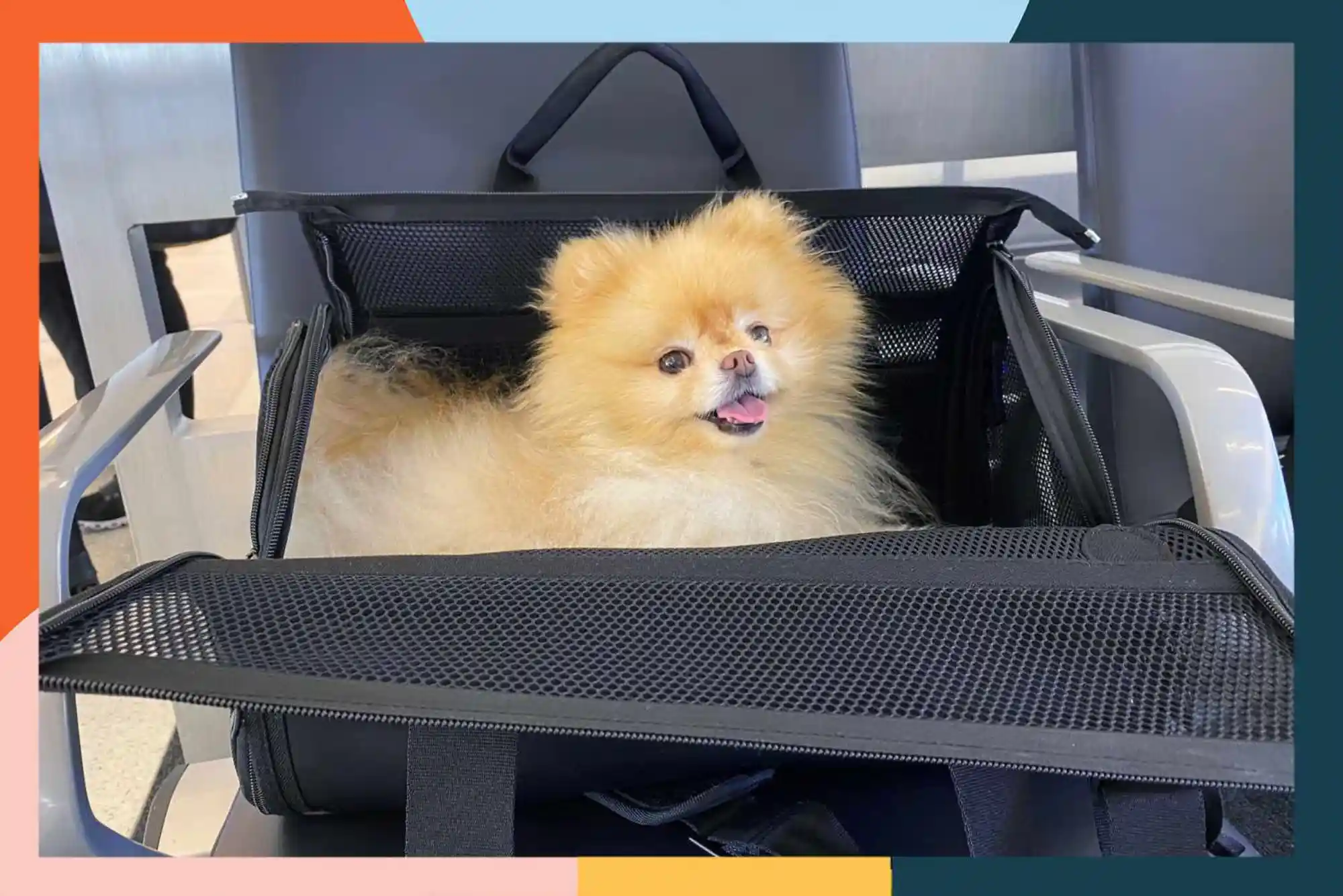
Look for generous mesh ventilation on multiple sides of the carrier. Multiple ventilation panels improve airflow and also allow you to check on your pet without repeatedly opening the carrier.
Ventilation should remain available after the carrier is placed beneath the seat. If a mesh panel becomes completely covered by the aircraft seat or pressed against another surface, the carrier may not provide the airflow you expected.
The carrier should also have secure openings that prevent your pet from escaping. A curious cat or anxious dog may test zippers and seams much more aggressively in an unfamiliar environment than at home.
Comfort Is Just as Important as Size
A carrier can meet an airline’s maximum dimensions and still be uncomfortable for your pet. Your animal should be able to remain inside the closed carrier without being cramped.
Southwest, for example, states that the cat or dog must be completely inside the carrier and able to stand up and move around with ease.
Before your trip, place your pet inside the carrier at home and observe its natural movements. Can your pet turn around without struggling? Can it sit normally? Can it lie down without having to curl into an unnatural position?
A washable padded base can also make a significant difference. Choose bedding that is comfortable but not so thick that it substantially reduces the carrier’s usable interior height.
Security Features You Should Look For
A quality carrier should feel secure from the moment you leave home until you reach your destination. Strong zippers are particularly important because some pets can push against weak closures.
A useful feature is a safety tether that attaches to a properly fitted harness. However, the tether should never be used to restrain a pet by its collar in a way that could create a choking hazard.
The carrier’s base should also resist sagging. A carrier with a floppy bottom can become uncomfortable to carry and may shift unexpectedly when placed beneath an airplane seat.
A luggage sleeve can be helpful during airport transfers because it allows the carrier to sit securely over a rolling suitcase. Padded shoulder straps are another practical feature if you expect to walk long distances through terminals.
How Airline Rules Affect Your Carrier Choice
There is no universal airline-approved size. Instead, the carrier needs to meet the requirements of the airline operating your flight.
American Airlines currently says soft-sided carriers can be up to 18 x 11 x 11 inches on its published carry-on pet guidelines, although the airline notes that aircraft-specific restrictions can apply. It also prohibits pets in certain seats, including bulkhead and exit-row locations where under-seat storage may not be available.
Southwest publishes its own carrier limits and specifically notes that under-seat space varies by seat type and aircraft. It also says aisle seats may have more limited space for pet carriers.
Alaska Airlines currently states that dogs traveling in the cabin must fit inside a soft-sided carrier no larger than 17 x 11 x 9.5 inches.
These differences demonstrate why buying a carrier first and checking the airline later can create problems. The safest approach is to choose your airline and flight first, verify its current pet policy, identify the aircraft where possible, and then select a carrier that fits those requirements.
How to Prepare Your Pet for the Flight
Even one of the best airline approved pet carriers will not automatically make your pet comfortable with air travel. Carrier training should begin well before departure.
Leave the carrier open at home and allow your pet to investigate it voluntarily. Place familiar bedding inside and occasionally offer treats near or inside the carrier. Gradually increase the amount of time your pet spends inside.
Once your pet is comfortable, practice carrying the carrier around the house and taking short trips outside. This helps your animal become accustomed to movement and unfamiliar surroundings.
You should also practice keeping the carrier closed for longer periods. The goal is not simply to get your pet into the carrier but to make the carrier feel like a familiar, safe space.
Avoid making the carrier appear only when it is time to visit the airport. Pets can quickly learn to associate a carrier with stressful events such as veterinary appointments.
What to Pack Inside an In-Cabin Pet Carrier
The carrier should not be overloaded. Your pet needs usable interior space, so avoid filling it with unnecessary accessories.
A thin washable absorbent pad can help protect the bottom in case of an accident. A familiar-smelling piece of bedding may also provide comfort, provided it does not interfere with ventilation or movement.
Keep food, medications, cleanup supplies, and other travel essentials accessible in your personal luggage rather than stuffing the carrier.
Water planning is also important. Depending on your airline and the stage of travel, you may not be able to provide a conventional water bowl inside the carrier without creating a spill. Check your airline’s current instructions and plan accordingly.
Common Mistakes to Avoid When Choosing a Pet Carrier
One common mistake is buying a carrier based only on a product description that says “airline approved.” That phrase does not guarantee acceptance by every airline.
Another mistake is choosing the largest possible carrier. Bigger is not always better when the carrier has to fit under a particular aircraft seat. The correct carrier should provide sufficient room for your pet while remaining within the airline’s exterior dimensions.
Travelers also sometimes forget that a carrier can count toward their cabin baggage allowance. For example, Southwest states that its pet carrier counts as either a personal item or carry-on item.
Finally, never assume that a carrier accepted on a previous flight will automatically be accepted on your next trip. Aircraft, routes, seat configurations, and airline policies can change.
A Simple Way to Choose the Right Carrier
Start by checking the airline’s current pet policy. Confirm whether cats or dogs are permitted in the cabin, what carrier dimensions are allowed, whether there are weight restrictions, and which seats cannot be used.
Next, measure your pet while standing and sitting. Make sure the carrier provides enough interior room for normal movement.
Then compare the carrier’s outside dimensions with the airline’s published maximum. If your itinerary involves multiple airlines, check the rules of every operating carrier rather than relying on the first airline’s requirements.
Finally, test the carrier at home. Place your pet inside, close it securely, and carry it for several minutes. Check that the structure remains stable and that ventilation openings remain unobstructed.
FAQs
What size pet carrier will fit under an airline seat?
There is no single size that fits every airline or aircraft. Many U.S. airlines use dimensions around the 18 x 11 x 11-inch range for soft-sided carriers, but individual requirements can be smaller or different. American Airlines, for example, publishes 18 x 11 x 11 inches for soft-sided carriers, while Alaska Airlines currently lists 17 x 11 x 9.5 inches for its in-cabin dog carriers.
The important point is to check the airline operating your specific flight rather than relying on a general industry measurement.
Can I bring a pet carrier on a plane?
Yes, if the airline permits pets in the cabin and your pet and carrier meet its requirements. The FAA allows individual airlines to decide whether pets may travel in the passenger cabin. When permitted, the carrier must be appropriately stowed beneath the seat and remain there during required phases of flight.
Can my dog sit on my lap during the flight?
For ordinary in-cabin pet travel, you should expect your dog to remain inside its closed carrier under the seat according to the airline’s rules. The FAA requires an in-cabin pet container to remain properly stowed during aircraft movement, taxi, takeoff, and landing.
Service animals are governed by different rules and should not be confused with ordinary pet travel.
Do airlines allow hard-sided pet carriers in the cabin?
Some airlines may permit certain hard-sided carriers, but the dimensions can be more restrictive than those for soft-sided carriers. American Airlines, for example, publishes different hard-sided dimensions for mainline and American Eagle aircraft.
Because rigid carriers cannot compress, a soft-sided design is often more practical when under-seat clearance is tight.
Does a pet carrier count as a carry-on?
It depends on the airline. Southwest states that a pet carrier counts as either a carry-on bag or personal item. Other airlines have their own baggage rules.
Always check the baggage policy together with the pet policy before packing your other cabin luggage.
Should I choose an expandable pet carrier for flying?
An expandable carrier can be useful at the airport or after landing, but the expanded section generally cannot be used to occupy additional cabin space during flight. The carrier still needs to comply with the airline’s under-seat requirements when it is stowed.
For an in-cabin flight, prioritize the carrier’s closed dimensions, ventilation, structure, and comfort rather than the size of its expansion section.
Choosing among the best airline approved pet carriers is ultimately about finding the right balance between airline compliance, under-seat fit, ventilation, security, and your pet’s comfort. A carrier that looks excellent online may not be appropriate for your particular aircraft, so published dimensions should always be treated as airline-specific requirements rather than universal standards.