
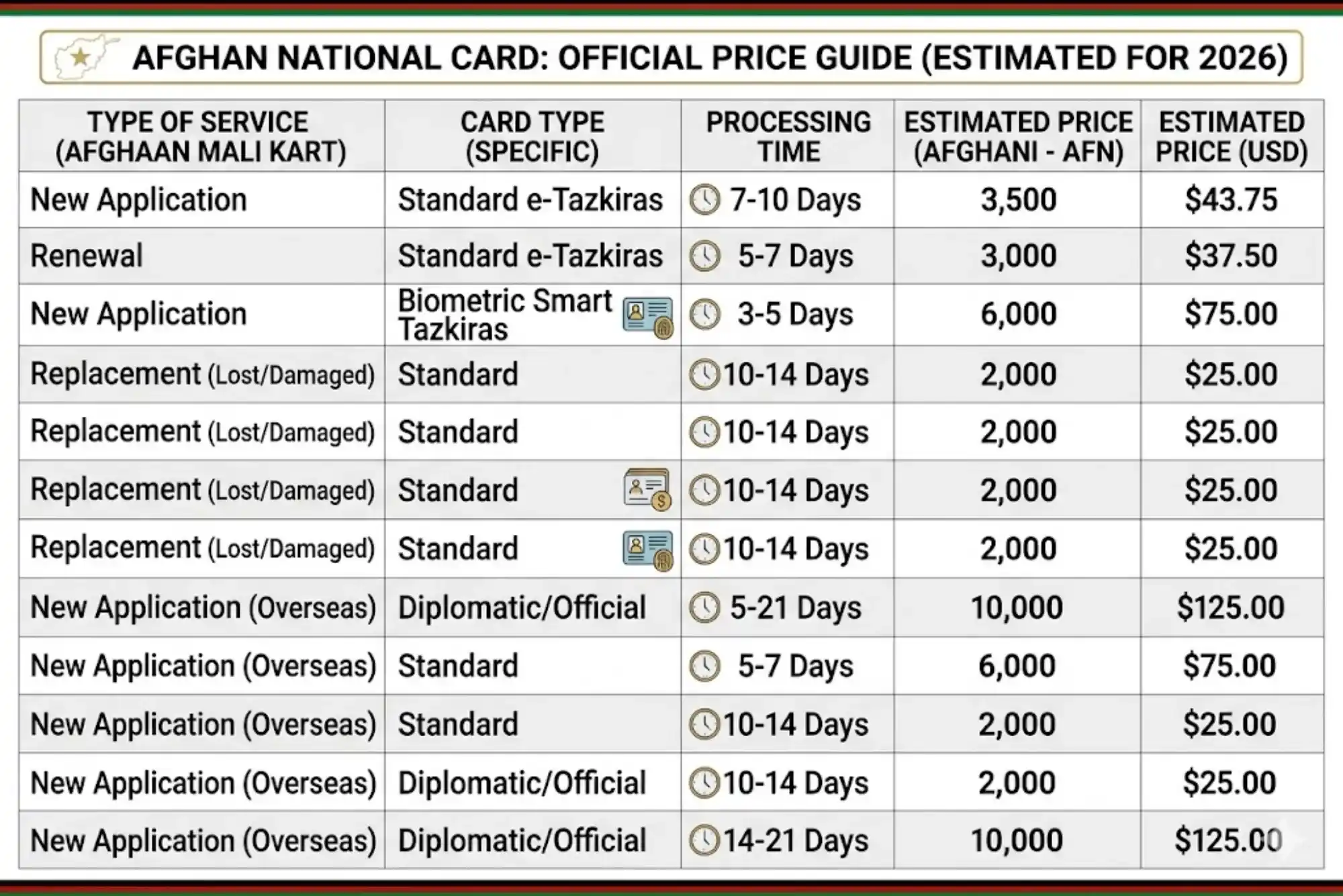
The Afghan National Card, commonly known as the Tazkira or electronic National ID, is one of the most critical identity documents for Afghan citizens living inside Afghanistan and abroad. As registration and issuance processes have continued to evolve in 2026 — particularly for Afghans residing in Pakistan, Iran, the Gulf countries, and Europe — understanding the Afghan National Card price in 2026 has become a genuinely practical concern. This guide covers every fee component involved in obtaining, renewing, or replacing an ANC, including government charges, service center fees, and ancillary costs that applicants often underestimate.
What Is the Afghan National Card?
The Afghan National Card is an official identity document issued by the Afghan government to its citizens. It serves as proof of nationality, age, and civil registration. The card exists in two forms: the traditional paper-based Tazkira, which has been in use for decades, and the newer electronic Tazkira (e-Tazkira), which includes biometric data and is part of Afghanistan’s broader civil registration modernization effort.
For Afghan nationals living outside the country, the card is typically issued or renewed through Afghan consulates and embassies in their country of residence. The process, fees, and document requirements vary depending on whether the applicant is a first-time registrant, renewing an existing card, or replacing a lost or damaged document.
Afghan National Card Price Overview for 2026
The fees associated with the Afghan National Card in 2026 are not uniform across all application channels or countries. Government charges are set by the Afghan Ministry of Interior’s civil registration authority, but consular processing fees, service center charges, and ancillary costs vary significantly based on location. The table below summarizes the primary fee components applicable in 2026.
| Service Type | Applicable Situation | Estimated Fee (USD) |
|---|---|---|
| New Registration (First-Time Applicant) | Never had an Afghan ID before | $10 – $30 |
| Renewal (Valid Tazkira Expiring) | Existing card nearing expiry | $15 – $40 |
| Replacement (Lost or Damaged Card) | Card lost, stolen, or damaged | $20 – $60 |
| e-Tazkira (Electronic Version) | Upgrade fro paper to electronic | $30 – $80 |
| Child Registration | Minor under 18 years | $5 – $20 |
| Correction of Information | Name, date of birth, or other data error | $15 – $50 |
These are estimated ranges based on consular fee schedules at Afghan missions in various countries. The exact amount differs by location — fees at missions in Gulf countries, Europe, and South Asia are not identical. Always contact the specific Afghan consulate or embassy in your country of residence to confirm the current fee before submitting documents or making any payment.
Complete Cost Breakdown: What Applicants Actually Pay
Beyond the government or consular fee, the total cost of obtaining or renewing an Afghan National Card involves several additional charges that applicants consistently underestimate during their budget planning. Here is a realistic breakdown of the full cost for an adult applicant applying through an Afghan consulate in a third country.

| Cost Component | Estimated Range (USD) | Notes |
|---|---|---|
| Consular / Government Processing Fee | $10 – $80 | Depends on service type and location |
| Document Authentication or Notarization | $20 – $80 | Required for supporting civil documents |
| Translation of Supporting Documents | $15 – $60 per document | For applicants submitting foreign-language records |
| Biometric Enrollment (where applicable) | $10 – $30 | Required for e-Tazkira applications |
| Passport Photos (to specification) | $5 – $20 | Typically 4–6 photos required |
| Courier or Document Delivery Fee | $10 – $50 | For applicants receiving documents by post |
| Agent or Facilitation Fee (optional) | $30 – $200 | For applicants using document processors or agents |
| Estimated Total | $70 – $520+ | Range reflects variation by country and case complexity |
The wide range in total cost reflects both the diversity of applicant situations and the location factor. An Afghan national in Dubai applying for a straightforward renewal with clean documentation will pay considerably less than someone in Europe who needs extensive document translation and must use a courier service for passport delivery.
Fees by Country: Regional Comparison
The Afghan consular fee for National Card services is not the same across all countries. Afghan embassies and consulates set their own local fee schedules based on administrative costs and the currency environment of their host country. The following regional comparison gives applicants a practical reference point, though all figures should be verified directly with the relevant mission.
| Region / Country | Approximate Consular Fee (USD Equivalent) | Currency Typically Accepted |
|---|---|---|
| Pakistan (Islamabad / Peshawar / Karachi) | $5 – $25 | Pakistani Rupee (PKR) |
| Iran (Tehran) | $10 – $35 | Iranian Rial or USD equivalent |
| UAE (Dubai / Abu Dhabi) | $25 – $80 | UAE Dirham (AED) |
| Qatar (Doha) | $25 – $75 | Qatari Riyal (QAR) |
| Germany (Berlin) | $40 – $100 | Euro (EUR) |
| United Kingdom (London) | $45 – $110 | British Pound (GBP) |
| Turkey (Ankara / Istanbul) | $20 – $60 | Turkish Lira or USD |
The higher fees in Western European countries and the Gulf reflect both administrative overhead and the higher cost of operating consular services in those markets. Applicants in countries where the Afghan mission is less active or has reduced staffing may also experience longer processing times alongside higher fees due to the limited capacity available at those locations.
Documents Required for Afghan National Card Application
The document requirements vary depending on whether you are applying for the first time, renewing, or replacing a card. Below is the general list applicable to most standard applications processed through Afghan missions abroad.
- Completed application form (available at the consulate or downloadable from the mission’s official portal)
- Valid Afghan passport or existing Tazkira (original and copies)
- Recent passport-sized photographs meeting the consulate’s specification (typically white background, taken within the last six months)
- Proof of Afghan nationality or family registration records (Shajra-nama or family booklet)
- Proof of current residence in the host country (valid residence permit, utility bill, or tenancy agreement)
- For replacement: police report confirming loss or theft of the original card
- For correction requests: supporting documents evidencing the correct information (birth certificates, school records, etc.)
- For child registration: parent’s valid ANC or Tazkira, and birth registration certificate where available
Applicants who need to authenticate Afghan civil documents issued inside Afghanistan often face an additional challenge — formal apostille and authentication channels between Afghanistan and most countries are currently limited. In practice, this means many documents require verification through alternative pathways that can add both time and cost to the process. Consulting with the specific mission about accepted document verification methods before applying saves significant effort.
For Afghan nationals who are also managing travel planning alongside their identity document renewal, understanding broader cost structures for international travel can be useful. Our guide to airline ticket pricing trends covers fare patterns across key routes frequently used by Afghan diaspora communities in the Gulf and Europe.
Processing Times for Afghan National Card Applications in 2026
Processing times for ANC applications vary considerably depending on the mission’s current workload, staffing levels, and whether the application requires any additional verification steps. Afghan missions in high-volume locations like Islamabad and Dubai tend to have longer waiting periods than smaller missions, though the availability of digital application systems has helped reduce backlogs at some locations.
| Application Type | Typical Processing Time | Notes |
|---|---|---|
| Standard Renewal | 2 – 6 weeks | Straightforward cases with complete documents |
| New Registration (First-Time) | 4 – 10 weeks | May require additional verification |
| Replacement (Lost / Damaged) | 3 – 8 weeks | Police report and additional verification required |
| e-Tazkira Upgrade | 4 – 12 weeks | Biometric data processing adds time |
| Information Correction | 6 – 16 weeks | Requires back-end civil registry verification |
Applicants are advised not to use their ANC or Tazkira as supporting documentation for time-sensitive visa or travel applications while the renewal is in process. Keeping digital copies of all identity documents and submission receipts is essential for managing this overlap period without disruption to other administrative processes.
How to Apply for an Afghan National Card from Abroad
Identify your nearest Afghan mission — locate the embassy or consulate with jurisdiction over your current country of residence.
Determine the correct service type — new registration, renewal, replacement, or correction — and confirm the associated fee with the mission directly.
Gather all required documents including identity proofs, photographs, residence documentation, and any supporting civil records relevant to your application.
Complete the application form — obtain the correct form from the consulate in person or through their official website if available online.
Submit your application and pay the fee — most missions require in-person submission at the consular window; some accept pre-booked appointment slots.
Attend biometric appointment if required — e-Tazkira applications typically require fingerprinting and a digital photograph taken at the mission.
Await notification — the mission will contact you when your card is ready for collection or dispatch by courier.
Afghan nationals residing in countries where consular access is limited due to political or logistical factors may face additional barriers in this process. In some cases, a trusted representative or family member with a valid power of attorney can submit documents on behalf of the applicant, though policies on this vary by mission. For verified current information on application procedures, always refer to the official Afghan Ministry of Foreign Affairs website or the specific mission’s published guidelines.
Common Reasons for ANC Application Delays or Rejections
Incomplete documentation: Missing a single required document is the most frequent cause of delay. Confirm the full checklist before your appointment.
Inconsistent information: Discrepancies between the application form and supporting documents — particularly around dates of birth or spelling of names — trigger verification holds that can extend processing by weeks.
Outdated photographs: Photos taken more than six months ago or not meeting the specification (size, background, expression) are commonly rejected at the intake stage.
Insufficient proof of residence: Many missions require a valid, current residence permit in the host country. Expired or informal documentation is not accepted.
Unverifiable civil records: For applicants whose birth or family registration records originate from areas where official records are no longer accessible, additional verification steps are required and processing times increase significantly.
Afghan nationals who are also navigating broader legal or administrative processes in their country of residence — whether related to residency status, employment authorization, or other matters — may find it valuable to understand how legal timelines work in their host country. Our overview of legal case resolution timelines in Dubai is relevant for Afghan residents in the UAE managing concurrent documentation and legal processes.
Frequently Asked Questions
What is the Afghan National Card price in 2026 for a standard renewal?
A standard ANC renewal through an Afghan consulate abroad typically costs between $15 and $40 in government processing fees, depending on the country. Total costs including document preparation, translation, and any courier fees generally range from $70 to $200 for a complete, straightforward renewal case.
Can I apply for an Afghan National Card online?
Some Afghan missions have introduced online appointment booking systems, but most ANC applications still require in-person submission for document verification and biometric enrollment. The availability of online services varies significantly by country. Check with your nearest Afghan mission for their current application method.
How long is an Afghan National Card valid?
Traditional paper-based Tazkiras do not carry a formal expiry date in the same way that modern ID cards do. The electronic Tazkira issued under the newer civil registration system is typically valid for ten years. Applicants should confirm the validity period for their specific card type when collecting the document from the consulate.
Are Afghan National Card fees refundable if the application is rejected?
Consular fees paid at Afghan missions are generally non-refundable, regardless of the outcome. This makes it particularly important to ensure your documentation is complete and accurate before submitting. In cases of administrative error by the consulate, refunds or reprocessing without additional charge may be possible — but this requires formal follow-up.
What should I do if the information on my Afghan National Card is incorrect?
Errors in name, date of birth, or other civil information must be corrected through a formal correction request at the Afghan mission. This process typically requires supporting documents that evidence the correct information, such as school records or birth certificates. Correction cases take longer to process than standard renewals and may attract a higher service fee.
Final Thoughts
The Afghan National Card price in 2026 is manageable when viewed in isolation, but the full cost of a successful application — including document preparation, translation, authentication, and service fees — can reach several hundred dollars depending on your circumstances and location. For Afghan nationals abroad, the key to keeping costs under control is thorough preparation: confirming the exact requirements with your specific mission, gathering all documents before your appointment, and avoiding the need for re-submissions that reset processing timelines and add unnecessary expense.
Whether you are applying for the first time, renewing ahead of an expiry, or replacing a lost document, the Afghan National Card remains an essential foundation for accessing official services, proving identity, and maintaining your civil status as an Afghan citizen wherever you are in the world.